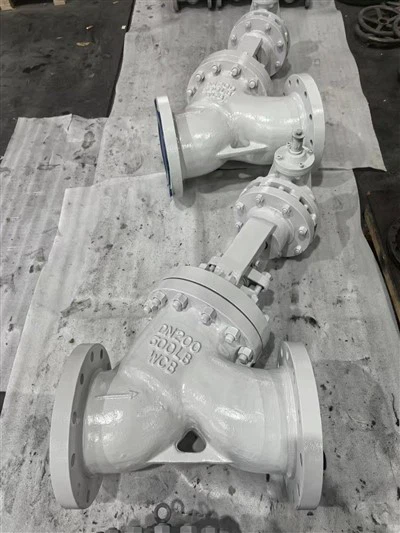
Analysis of the Differences Between Single-Disc Gate Valves and Double-Disc Gate Valves
Single-disc gate valves and double-disc gate valves both belong to the gate valve category with the core function of controlling pipeline opening and closing by lifting the gate disc but they differ fundamentally in gate disc structural design sealing mechanism and operating adaptability with details as follows:
I. Core Structural Differences
1. Single-Disc Gate Valve
The single-disc gate valve adopts a single integral gate disc which is either solid or has a small number of weight-reducing grooves and is usually made of metal materials (such as cast steel stainless steel cast iron) while engineering plastics can be used in some low-pressure scenarios. The gate disc cross-section is typically wedge-shaped (with a wedge angle of 2°52′-5°) or parallel with no movable connecting parts resulting in a simple and rigid structure. The valve stem is directly connected to the gate disc (mostly via rising or concealed stem threaded connections) and during opening and closing the valve stem drives the gate disc to move up and down as a whole. The gate disc has no independent opening or closing movement and relies entirely on the guidance and restraint of the valve body and valve seat. No additional elastic or adjustment components are required and fitting accuracy is ensured only through precision machining of the gate disc and valve seat while some models overlay hard alloys (such as Cr13 Stellite alloy) on the gate disc sealing surface to enhance wear resistance.
2. Double-Disc Gate Valve
The double-disc gate valve consists of two independent sub-gate discs connected by elastic elements (such as springs elastic gaskets) to form a "double-flap" structure allowing slight opening and closing. The sub-gate disc material is similar to that of the single-disc gate valve but their thickness is usually smaller than that of the single-disc gate valve of the same specification and the elastic elements are mostly stainless steel springs or oil-resistant rubber gaskets. The valve stem is connected to the intermediate transmission components (such as crossheads connecting pins) of the two gate discs and during opening and closing the valve stem first drives the entire assembly downward. After contacting the valve seat the two gate discs are pushed apart to both sides by the thrust of the elastic elements and tightly fit the valve seat; during opening the valve stem first pulls upward and the two gate discs are closed together under the guidance of the valve body before rising as a whole. It must be equipped with elastic compensation elements (spring compression is usually 0.5-2mm) and some high-pressure models add positioning pins between the two gate discs to prevent gate disc misalignment while low-pressure models may use rubber gaskets instead of springs to achieve elastic compensation.

II. Differences in Sealing Principles
1. Single-Disc Gate Valve
The single-disc gate valve relies on "rigid fitting sealing" and through precision machining of the gate disc and valve seat (sealing surface roughness Ra ≤ 0.8μm) combined with axial pressure when the valve is closed the gate disc sealing surface and valve seat sealing surface are in close contact to form a seal. It has no elastic compensation capability and the sealing effect depends entirely on machining accuracy and installation coaxiality. It achieves reliable sealing under stable working conditions (no temperature and pressure fluctuations) and clean media but once the gate disc or valve seat is worn or deformed it cannot self-compensate and the sealing surface must be ground or parts replaced to restore sealing. A large torque is required when closing (usually 1.5-2 times that of the double-disc gate valve) to ensure full fitting of the gate disc and valve seat and avoid "false closing" leading to leakage.
2. Double-Disc Gate Valve
The double-disc gate valve adopts "elastic expansion sealing" and when closing the two gate discs expand to both sides under the action of elastic elements to adapt to minor deviations of the valve seat (such as valve body casting deformation installation coaxiality error) fill the sealing gap and reduce dependence on machining accuracy. The sealing surface contact pressure is provided by both the elastic force of the elastic element and axial pressure resulting in more uniform pressure distribution. It has stronger adaptability to working condition fluctuations and when medium temperature changes cause thermal expansion and contraction of the gate disc and valve seat the elastic element can compensate for the gap in real time; a small amount of particle impurities can be "wrapped" by the elastically expanded sealing surface and are not easy to scratch the sealing surface directly with a leakage rate usually reaching ANSI Class V (some high-precision models reach Class VI). The closing torque is small because the elastic element assists in expanding the gate disc and there is no need to apply excessive axial force to achieve sealing which can reduce the load on the valve stem and actuator and extend service life.